
Director Theft: Legal Steps for Irish Companies
Director theft in Ireland? Stop further loss, secure evidence, suspend properly, and report to Gardaí. Here's your step-by-step legal response plan.
Who should read this
This article is for Irish company directors and business owners who've discovered that another director has been stealing from the company.
If you're facing theft by a director and need to know how to stop further losses, protect evidence, recover stolen funds, and navigate the legal process, this guide covers immediate protective steps, civil recovery procedures, criminal reporting obligations, and how to pursue personal liability against the director.
Key takeaways
- Immediately freeze bank accounts, change all passwords, and restrict building access to prevent further theft by the director.
- Suspend the director on full pay while investigating rather than dismissing immediately to avoid unfair dismissal claims.
- Directors who steal are personally liable to repay stolen funds plus interest and indemnify company losses.
- Apply for freezing injunctions to prevent directors dissipating stolen assets before judgment in urgent cases.
- Check fidelity and D&O insurance policies immediately as they may cover theft losses and investigation costs.
What should you do immediately after discovering theft?
Stop the bleeding first - your priority is preventing further loss while preserving evidence of what's already happened.
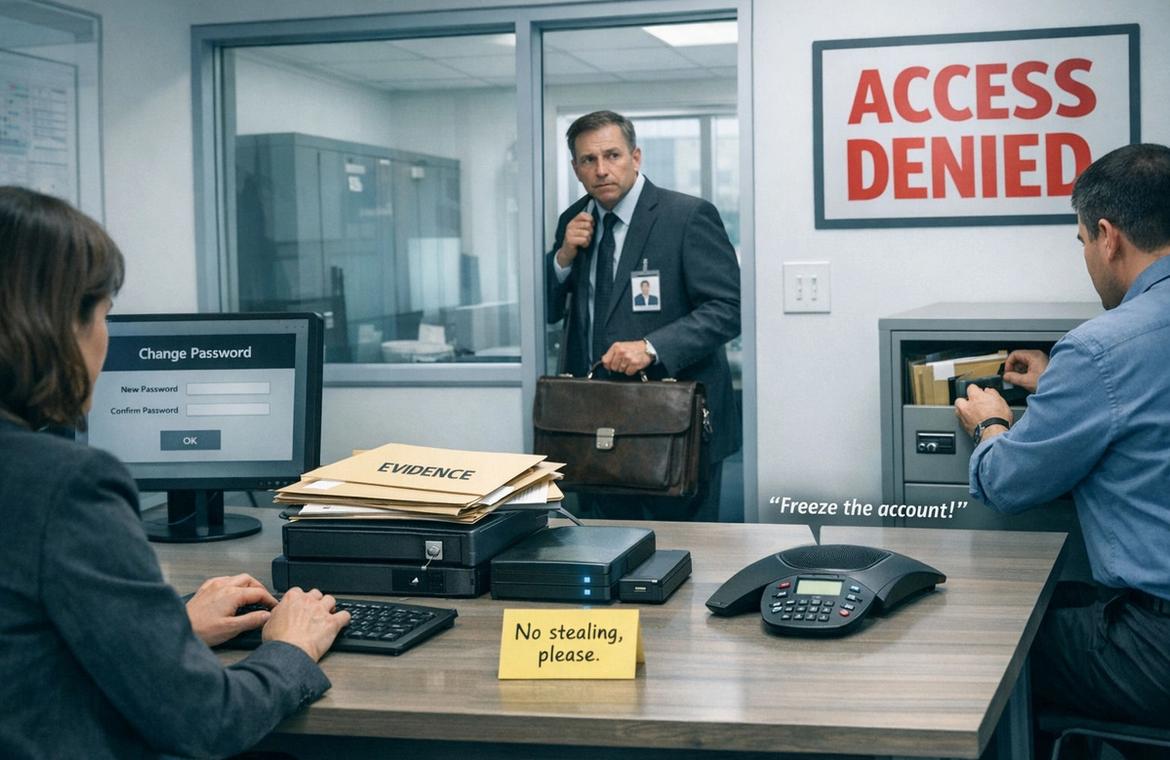
Take these immediate steps to protect the company:
- Freeze bank accounts - Contact your bank immediately to prevent further withdrawals and transfers by the director
- Change all passwords - Lock the director out of accounting systems, banking platforms, and company email accounts
- Restrict building access - Cancel security cards and change locks if the director has keys to premises
- Secure physical evidence - Lock away documents, computers, and files the director may try to destroy or alter
- Preserve electronic records - Back up emails, accounting records, and transaction histories before they can be deleted
Should you suspend or dismiss the director?
The law distinguishes between suspension pending investigation and outright dismissal, and getting this wrong exposes you to expensive unfair dismissal claims.
Suspension allows you time to investigate while protecting the company from further harm, you can suspend a director on full pay while investigating the allegations.
This protects the company while preserving the director's employment rights during the investigation process. Summary dismissal without notice is only justified for gross misconduct that you can prove immediately.
You need clear evidence of theft that breaches the fundamental trust required in the employment relationship. Dismissing without proper procedure opens you to unfair dismissal claims that can cost up to two years' salary.
What are your criminal reporting obligations?
Liquidators have statutory reporting obligations under the Companies Act 2014. In a solvent company, there is no automatic reporting duty on fellow directors, but suspected theft should be reported to An Garda Síochána and may need to be disclosed to the Corporate Enforcement Authority depending on the circumstances.
Theft by a director typically constitutes a Category 1 offence that must be reported.
What civil recovery procedures are available?
You have multiple legal routes to recover stolen funds and hold the director personally liable for losses caused to the company. The Companies Act 2014 creates automatic liability to account for profits and indemnify losses where directors breach fiduciary duties.
Directors who steal are in clear breach of their fiduciary duty to act in good faith in the company's interests. The company can bring proceedings for breach of these duties without needing to prove loss in some cases.
Stolen funds can be recovered plus interest from the date of theft, courts can impose constructive trusts over property acquired with stolen company funds.
This means assets purchased with misappropriated money are held on trust for the company.
What is liability to account?
Where directors breach their fiduciary duties under section 228, the court can order them to account for profits and indemnify the company for losses suffered.
The section states that directors who breach duties must account to the company for any profit made and indemnify losses.
Proof of dishonesty is not always required for breach of fiduciary duty, but the company must establish the breach and resulting gain or loss.
The director cannot avoid liability by arguing they intended to repay the money eventually.
Interest accrues on stolen amounts from the date of theft until full repayment.
Can you get freezing orders and injunctions?
Yes, the court can grant urgent interim relief to prevent directors dissipating stolen assets before judgment.
Courts have the power to restrain directors from removing or disposing of company assets.
Freezing injunctions prevent directors transferring stolen money or assets purchased with company funds.
You must show there is a real risk the director will dispose of assets if not restrained by court order.
The application can be made without notice to the director in urgent cases where giving notice would allow destruction of assets.
What about director disqualification?
Theft by a director provides strong grounds for disqualification proceedings preventing them serving as directors in future.
Courts can order the disqualification of a director where their conduct makes them unfit.
Conviction for theft would almost certainly result in automatic disqualification.
Disqualification can last from one year to life depending on the severity of misconduct.
How do criminal and civil proceedings interact?
Criminal prosecution and civil recovery proceedings can run simultaneously, though coordination is important to avoid prejudicing either case.
Evidence gathered for civil proceedings can be used in criminal prosecutions.
Strategic coordination is important. In some cases civil proceedings proceed first to secure assets; in others, parties may wait for the outcome of criminal proceedings.
Criminal convictions make civil cases much easier to prove since the criminal standard of proof is higher.
Directors convicted of theft cannot later deny the facts in civil proceedings due to issue estoppel.
What evidence do you need to prove theft?
Strong documentary evidence is essential for both criminal prosecution and civil recovery.
Gather the following evidence to build your case:
- Bank statements for company and director's personal accounts
- Accounting records and ledgers showing the theft
- Emails discussing or authorising suspicious transactions
- Invoices or expense claims that are fraudulent
- Witness statements from staff who observed suspicious behaviour
- Computer forensics showing deletion or alteration of records
Can you recover from the director personally?
Yes, the Companies Act 2014 creates personal liability allowing you to pursue the director's personal assets.
The company can obtain judgment against the director personally for stolen amounts plus compensation for losses.
If the director owns property, you can register a judgment mortgage to secure recovery.
Bankruptcy proceedings may be necessary if the director refuses to pay or dissipates assets.
What about company insurance?
Check your insurance policies immediately as some policies cover theft by directors up to specified limits.
Fidelity insurance specifically covers employee theft including by directors.
Directors' and officers' liability insurance may cover investigation costs and some losses.
Notify insurers promptly as many policies have strict notification deadlines.
Delays in notification can void coverage even for valid claims.
Irish Company Formation
Your Irish company, ready in days — not months.
Join 1,000+ founders who incorporated with Open Forest. We handle the paperwork, you focus on building.
No hidden fees/Fully compliant/Free consultation

Related articles


Mar 25, 2026 - 3 min read
Equity Dilution Explained: What Happens When You Issue Shares
Learn what share dilution means for founders, when it helps vs hurts, and how to protect your stake. Includes examples and cap table math.

Mar 19, 2026 - 3 min read
Co-Founder Competing Against You? Irish Law Explained
Co-founder competing against your company? Irish law gives you real tools to stop it. Here's what duties apply, how to act fast, and what you can claim.

Mar 18, 2026 - 4 min read
Board Deadlock: How to Break a Tie Vote in Ireland
Board deadlocks happen when directors can't agree and the vote is tied. Here's how casting votes work in Ireland and what to do if yours doesn't have one.

Frequently asked questions
Here's everything you need to know to get started, manage your account, and troubleshoot the most frequent issues.
Your first priority is stopping further loss while preserving evidence. Immediately freeze bank accounts, change all passwords to lock the director out of systems, restrict their building access, and secure both physical and electronic records before they can be destroyed or altered.
Summary dismissal is only justified if you have clear, immediate proof of theft that breaches fundamental trust. Dismissing without proper procedure can expose you to unfair dismissal claims costing up to two years' salary, so suspension on full pay while you investigate is often the safer approach.
In a solvent company, fellow directors don't have an automatic reporting duty, but suspected theft should be reported to An Garda Síochána. Theft by a director typically constitutes a Category 1 offence and may need to be disclosed to the Corporate Enforcement Authority depending on circumstances.
Yes, the Companies Act 2014 creates personal liability allowing you to pursue the director's personal assets for stolen amounts plus interest from the date of theft. Courts can impose constructive trusts over property the director purchased with stolen company funds, meaning those assets are held on trust for the company.
A freezing order is a court injunction that prevents the director from transferring or disposing of stolen money or assets purchased with company funds. You can obtain one by showing there's a real risk the director will dispose of assets, and in urgent cases, you can apply without giving the director notice.
Not always - proof of dishonesty isn't required for all breach of fiduciary duty claims under section 228. However, you must establish the breach occurred and show the resulting gain or loss, and the director cannot avoid liability by claiming they intended to repay the money eventually.
Both can run simultaneously, though strategic coordination is important to avoid prejudicing either case. Criminal convictions make civil cases much easier to prove since the criminal standard of proof is higher, and directors convicted of theft cannot later deny the facts in civil proceedings due to issue estoppel.
Check your policies immediately as fidelity insurance specifically covers employee theft including by directors, and some policies cover losses up to specified limits. Notify insurers promptly as many policies have strict notification deadlines - delays can void coverage even for valid claims.
Yes, theft provides strong grounds for disqualification proceedings that can prevent them serving as directors for one year to life depending on severity. Conviction for theft would almost certainly result in automatic disqualification from holding directorships.
Questions are welcome.
We’ll point you in the right direction.
Share a few details below and our team will follow up with guidance for your Ireland or UK company.