
Protective Provisions Explained: Irish Investor Rights Guide
Protective provisions give investors veto rights over key decisions. Find out when they're used legitimately, when they become obstructive, and how to resolve deadlock.
Who should read this
This article is for Irish startup founders and business owners dealing with investor disputes over decision-making rights.
If you're facing an investor who's blocking company decisions or threatening to veto actions outside their agreed scope, this guide covers what protective provisions actually allow, when investor behaviour crosses into obstruction, and your options for resolving deadlock through negotiation or legal remedies.
Key takeaways
- Protective provisions grant investors veto rights only over specifically listed matters in shareholders' agreements, not blanket control.
- Investors act obstructively when blocking decisions outside their veto scope or demanding unrelated concessions to approve legitimate matters.
- Majority shareholders can pass ordinary resolutions on non-protected matters regardless of investor objections or veto threats.
- Well-drafted shareholders' agreements should include deadlock mechanisms like escalation procedures, shotgun clauses, or independent director tie-breakers.
- Negotiating a buyout at fair valuation typically resolves disputes faster and cheaper than Section 212 oppression litigation.
What Are Protective Provisions and Where Do They Come From?
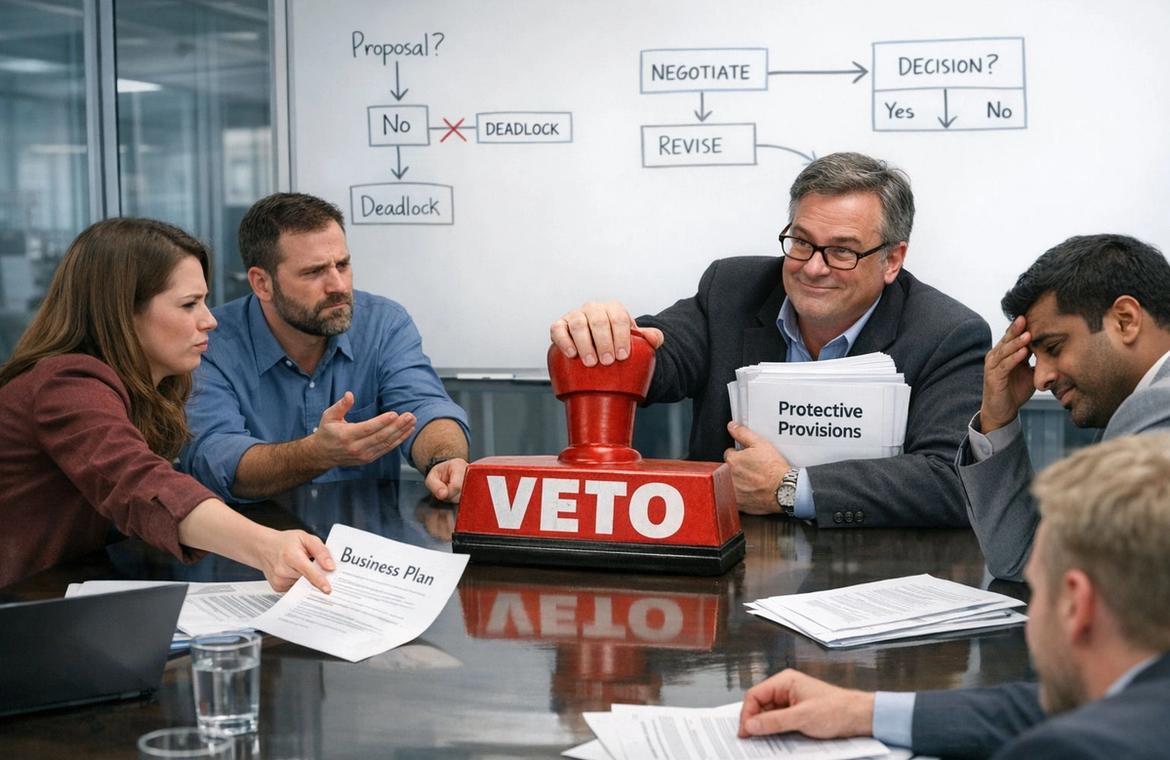
Protective provisions are veto rights granted to investors through shareholders' agreements. These contractual rights allow investors to block specific decisions even when they don't hold majority voting power, protecting their investment from actions that could materially harm their interests.
Common Protective Provision Areas
- Fundraising Decisions: Issuing new shares or raising additional investment capital.
- Director Appointments: Changing board composition or removing investor-nominated directors.
- Major Expenditure: Spending beyond agreed budgets or capital allocation limits.
- Asset Disposal: Selling substantial company assets or business divisions.
- Strategic Changes: Fundamentally altering business model, products, or target markets.
- Related Party Transactions: Deals between company and founders or their affiliates.
When Are Protective Provisions Being Used Legitimately?
Investors exercise protective provisions legitimately when proposed decisions fall within their agreed veto scope. If your shareholders' agreement gives investors veto over fundraising and you're trying to raise money, their blocking that decision represents proper use of contractual rights they negotiated. Legitimate veto examples include blocking equity rounds that would dilute investor ownership substantially or preventing expenditure from exceeding agreed financial limits. We also see these provisions being used to refuse sale offers which were below the agreed minimum valuation threshold and to prevent the removal of investor-appointed board members.
What Constitutes Obstructive Use of Protective Provisions?
Obstruction occurs when investors block decisions outside their protective provision scope or use legitimate provisions to extract additional benefits. For example, if the shareholders' agreement doesn't give investors veto over hiring decisions but they're threatening to block other matters unless you fire someone, that crosses into obstructive behaviour.
Obstructive Behaviour Patterns
- Scope Creep: Claiming veto rights over matters not listed in protective provisions.
- Ransom Demands: Blocking legitimate decisions to extract unrelated concessions.
- Competitive Harm: Using veto to benefit investor's other portfolio companies.
- Personal Disputes: Blocking everything due to personal conflicts with founders.
- Information Fishing: Demanding unreasonable information before considering approval.
Can Majority Shareholders Override Investor Vetoes?
For matters outside protective provision scope, majority shareholders can pass ordinary resolutions regardless of investor objections. The shareholders' agreement creates contractual veto rights only for specifically enumerated matters, not blanket control over all company decisions. A simple majority of shareholders can pass resolutions on non-protected matters. The 75% threshold (special resolutions) is required for any constitutional amendments. It is important to be aware that vetoes apply only to specifically listed decision categories and some matters require only board approval, not shareholder votes.
What Is Section 212 Oppression and How Does It Apply?
Section 212 of the Companies Act 2014 provides relief when company affairs are conducted oppressively toward shareholders. This remedy can work both ways - founders can claim investor obstruction is oppressive, or investors can claim founders are ignoring legitimate protective provisions.
Oppression Elements
- Affairs Conducted Oppressively: Company business managed in unfairly prejudicial manner.
- Shareholder Impact: Specific shareholder's interests being unfairly disregarded.
- Legitimate Expectations: Breach of understandings shareholders reasonably relied upon.
- Court Discretion: Wide remedial powers including share purchase orders.
How Do You Prove Investor Behaviour Is Oppressive?
Courts examine whether investor conduct goes beyond protecting legitimate interests into unreasonable obstruction. Evidence of blocking routine operational decisions, making ransom demands, or systematically preventing normal business operations supports oppression claims, though the bar for proving oppression is relatively high. Evidence that helps includes records that show a pattern of blocking such as systematic veto of routine decisions or emails claiming veto over non-protected matters. It possible, it can be helpful to gather financial evidence showing any damage from blocked decisions.
What Deadlock Provisions Should Shareholders' Agreements Include?
Well-drafted shareholders' agreements anticipate deadlock and provide resolution mechanisms. These provisions offer faster, cheaper alternatives to court proceedings when investors and founders cannot agree on important decisions.
Effective Deadlock Mechanisms
- Escalation Procedures: Sequential steps from negotiation to mediation to arbitration.
- CEO Casting Vote: Give CEO decisive vote on operational matters within protective provision scope.
- Independent Director: Appoint neutral director with tie-breaking authority.
- Shotgun Clauses: Either party can trigger buy-sell process at stated valuation.
- Put Options: Allow investors to force company or founders to buy their shares.
- Drag-Along Rights: Enable majority to force sale over investor objections.
Can You Amend Shareholders' Agreement to Remove Protective Provisions?
Shareholders' agreements typically require unanimous consent for amendments. This means obstructive investors can prevent removal of the very provisions they're abusing, creating a situation that often requires court intervention or commercial negotiation. Most agreements need all shareholders to approve changes and obstructive investors won't voluntarily surrender veto rights. In our experience, offering to buy out the particular investor may resolve the deadlock.
What Remedies Can Courts Order Under Section 212?
Courts have broad discretion to remedy oppressive conduct, including ordering share purchases, appointing receivers, or regulating future company conduct. The most common remedy involves one party buying out the other at fair value determined by independent valuation.
Available Court Remedies
- Share Purchase Orders: Requiring company or other shareholders to buy complainant's shares.
- Reverse Buy-Out: Ordering complainant to sell shares to other shareholders.
- Conduct Regulation: Directing how company affairs must be managed going forward.
- Account Orders: Requiring accounting for profits or compensation for losses.
- Winding Up: Ordering company dissolution in extreme deadlock cases.
Should You Negotiate Buyout Instead of Litigating?
Commercial settlement often provides faster, cheaper resolution than court proceedings. Offering to buy out obstructive investors at fair valuation removes the problem permanently while avoiding expensive litigation that damages all shareholders through legal costs and management distraction.
Settlement Considerations
- Valuation Method: Agree independent expert to value shares fairly.
- Payment Terms: Structure consideration as upfront payment or installments.
- Clean Exit: Ensure investor releases all claims and obligations.
- Speed Advantage: Settlement achieved in weeks versus years of litigation.
- Cost Savings: Legal fees for settlement negotiation far lower than trial costs.
- Business Continuity: Management focuses on operations rather than litigation.
Can You Continue Operating During Disputes?
Yes, the company continues operating for decisions outside protective provision scope. It is important for companies in this situation to focus on business matters that are within your control, while resolving deadlock through negotiation or legal proceedings for blocked items.
Irish Company Formation
Your Irish company, ready in days — not months.
Join 1,000+ founders who incorporated with Open Forest. We handle the paperwork, you focus on building.
No hidden fees/Fully compliant/Free consultation

Related articles


Mar 25, 2026 - 3 min read
Equity Dilution Explained: What Happens When You Issue Shares
Learn what share dilution means for founders, when it helps vs hurts, and how to protect your stake. Includes examples and cap table math.

Mar 19, 2026 - 3 min read
Co-Founder Competing Against You? Irish Law Explained
Co-founder competing against your company? Irish law gives you real tools to stop it. Here's what duties apply, how to act fast, and what you can claim.

Mar 18, 2026 - 4 min read
Board Deadlock: How to Break a Tie Vote in Ireland
Board deadlocks happen when directors can't agree and the vote is tied. Here's how casting votes work in Ireland and what to do if yours doesn't have one.

Frequently asked questions
Here's everything you need to know to get started, manage your account, and troubleshoot the most frequent issues.
Protective provisions are veto rights granted to investors through shareholders' agreements that allow them to block specific decisions even without majority voting power. These contractual rights protect investors from actions that could materially harm their interests, such as issuing new shares, changing the board composition, or making major expenditures beyond agreed budgets.
Yes, but only for matters outside the protective provision scope listed in your shareholders' agreement. For non-protected matters, a simple majority of shareholders can pass ordinary resolutions regardless of investor objections, while constitutional amendments require a 75% threshold.
Legitimate use occurs when investors block decisions that fall within their agreed veto scope, such as preventing fundraising that would substantially dilute their ownership. Obstructive use happens when investors claim veto rights over matters not listed in the protective provisions or use legitimate provisions to extract unrelated concessions, like threatening to block decisions unless you fire someone.
Courts examine whether investor conduct goes beyond protecting legitimate interests into unreasonable obstruction. Evidence that helps includes records showing systematic veto of routine decisions, emails claiming veto over non-protected matters, and financial evidence demonstrating damage from blocked decisions, though the bar for proving oppression under Section 212 is relatively high.
Most shareholders' agreements require unanimous consent for amendments, which means obstructive investors can prevent removal of the very provisions they're abusing. This situation often requires court intervention or commercial negotiation, with offering to buy out the investor being a common resolution approach.
Courts have broad discretion to remedy oppressive conduct, with the most common remedy being a share purchase order requiring the company or other shareholders to buy out shares at fair value determined by independent valuation. Other remedies include appointing receivers, regulating future company conduct, or in extreme cases, ordering company dissolution.
Commercial settlement often provides faster and cheaper resolution than court proceedings, typically achieved in weeks versus years of litigation. Offering to buy out obstructive investors at fair valuation removes the problem permanently while avoiding expensive legal costs and management distraction that damages all shareholders.
Well-drafted agreements should include escalation procedures (from negotiation to mediation to arbitration), CEO casting votes on operational matters, independent directors with tie-breaking authority, shotgun clauses for buy-sell processes, put options allowing investors to force share purchases, and drag-along rights enabling majority to force sales. These mechanisms offer faster, cheaper alternatives to court proceedings when parties cannot agree.
Yes, the company continues operating for all decisions outside the protective provision scope. Focus on business matters within your control while resolving deadlock through negotiation or legal proceedings for the specific blocked items that fall under the investor's veto rights.
Questions are welcome.
We’ll point you in the right direction.
Share a few details below and our team will follow up with guidance for your Ireland or UK company.