
Irish Income Tax Credits: 2026 Guide to Claims
A plain guide to Irish income tax credits for 2026: which ones you qualify for, what they are worth, and how to claim refunds going back up to four years.
Who should read this
Ideal for Irish PAYE workers, self-employed, pensioners, home carers, elderly (65+), parents with dependents, and those incurring medical or nursing home expenses who want to reduce tax bills.
You'll gain precise 2026 credit rates, eligibility rules, automatic vs. manual claims processes, examples, checklists, and tips to maximize refunds including prior years.
Key takeaways
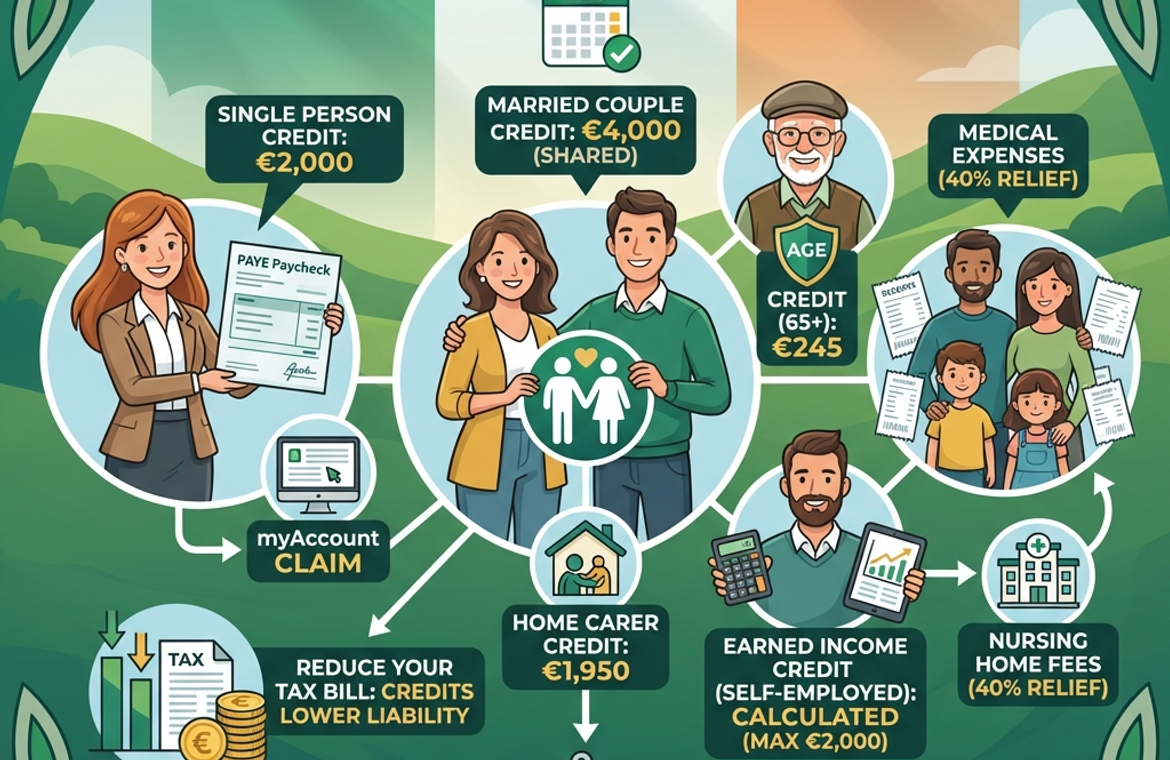
- Personal Tax Credit: €2,000 single, €4,000 married/civil partners for 2026, automatic.
- Employee/Earned Income Credit up to €2,000 based on PAYE or self-employment income at 20%.
- Home Carer €1,950 (income limits), Dependent Relative €305 (relative income ≤€18,028), Age €245.
- Medical relief 20% standard, 40% nursing home/home carer employment (up to €75,000).
- Review Tax Credit Certificate yearly; claim via myAccount, backdate 4 years; keep receipts 6 years.
Understanding Your Irish Income Tax Credits
Tax credits are one of the most valuable tools available to reduce your income tax liability in Ireland. Unlike tax reliefs that reduce your taxable income, tax credits directly reduce the amount of tax you owe. This guide explains the main tax credits available for 2026 and how to ensure you're claiming everything you're entitled to.
For 2026, many of the most common tax credit rates remain unchanged from 2025. However, it's crucial to understand which credits apply to your circumstances and how to claim them properly.
1. Standard Personal Tax Credits Available to All Taxpayers
These are the foundational credits that form the basis of Ireland's income tax system. Most taxpayers will be entitled to at least some of these credits.
Personal Tax Credit
The Personal Tax Credit is available to all taxpayers and is applied automatically once you're registered with Revenue. For single individuals in 2026 the pesonal credit is €2,000. For a married couple/civil partners the credit is €4,000 (€2,000 each).
Employee Tax Credit (PAYE Credit)
If you're employed and pay tax through the PAYE system, receive a pension, or get certain taxable social welfare payments, you're entitled to the Employee Tax Credit of €2,000 for 2026.
Key points about the PAYE Credit:
Earned Income Credit
The Earned Income Credit was introduced to provide equivalent relief for self-employed individuals, proprietary directors, and others with non-PAYE income.
For 2026:
Example: Sarah has €8,000 in PAYE income and €4,000 in self-employment income. She can claim €1,600 PAYE credit (€8,000 × 20%) and an Earned Income Credit of €400 (capped at €2,000 combined - €2,000 less the €1,600 PAYE credit already claimed)"
2. Age-Related Credits, Dependent Relative Credit, and Home Carer Credit
Age Tax Credit
If you're aged 65 or over, you're entitled to an additional age-related tax credit. For single individuals in 2026 the age credit is €245. For a married couple/civil partners the credit is €490 (€245 each). This credit is usually applied automatically once your age details are correctly registered with Revenue.
Dependent Relative Tax Credit
You can claim this credit if you maintain a dependent relative at your own expense.
Credit Amount for 2026: €305 per qualifying relative
Who qualifies as a dependent relative?
Critical Income Limit: Your dependent relative's total income cannot exceed €18,028 in 2026. If their income exceeds this amount, you will not receive the tax credit for that year. This limit includes all income sources including social welfare payments, pensions, and deposit interest.
Home Carer Tax Credit
This credit is available if you're married or in a civil partnership, jointly assessed for tax, and one partner cares for a dependent person in the home.
Credit Amount for 2026: €1,950 (unchanged from 2025)
Who counts as a dependent person?
Note: The dependent person cannot be your spouse or civil partner
Income Calculation:
If the home carer's income exceeds €7,200, the credit is reduced by half the difference between the actual income and €7,200.
Example: If the carer earns €9,000, the excess is €1,800. Half of €1,800 is €900. The credit is €1,950 - €900 = €1,050.
Important Note: Carer's Allowance and Carer's Benefit from the Department of Social Protection are not counted when determining the home carer's income limit, but they are taxable income that forms part of your jointly assessed income.
3. Medical and Health-Related Credits and Reliefs
Ireland provides extensive tax relief for healthcare expenses, which can result in significant refunds for families with medical costs.
Health Insurance Relief
Tax relief on health insurance premiums is granted at source (TRS) by your insurance company, meaning you pay a reduced premium upfront rather than claiming back the relief.
However, if your employer pays your health insurance premium as a benefit, you may need to claim the relief directly through Revenue’s myAccount. The Maximum Relief is €200 per adult and €100 per child.
Medical Expenses Tax Relief
You can claim tax relief on qualifying medical expenses that you pay for yourself or any other person, including family members and dependent relatives.
Relief Rate: Most medical expenses qualify for relief at the standard rate of 20%. However, nursing home expenses qualify for relief at your highest rate of tax (up to 40%).
Qualifying Medical Expenses:
Not Eligible for Relief:
Nursing Home Expenses Relief
Nursing home expenses receive special treatment and qualify for relief at your highest rate of tax - potentially 40% - making this one of the most valuable medical expense reliefs.
Requirements:
Example: If you pay €30,000 in nursing home fees and you're in the 40% tax bracket, you could claim relief of €12,000. This significantly reduces the net cost of care.
Tax Relief for Employing a Home Carer
If you employ a qualified nurse or carer to provide care at home for yourself or a family member who is totally incapacitated, you can claim tax relief on the cost.
Relief is given at your highest rate of tax (up to 40%).
The relief is the lower of:
Note: You cannot claim this relief if you're already claiming the Dependent Relative Tax Credit or Incapacitated Child Tax Credit for the same person.
4. How to Claim Tax Credits: Through Your Employer and via Revenue
There are two main ways to ensure you receive your tax credits: automatic application through your employer's payroll and direct claims through Revenue.
Automatic Credits Through Your Employer
Many standard tax credits are applied automatically through the PAYE system once your tax details are correctly registered.
Credits Usually Applied Automatically:
How to Check Your Credits:
Important: Review your Tax Credit Certificate at least annually and always check it when your circumstances change (marriage, new job, caring for a dependent, etc.).
Claiming Credits Directly Through Revenue
Some credits must be claimed actively through Revenue's myAccount system or by submitting a tax return.
Credits That Must Be Claimed:
Step-by-Step: Claiming Credits via myAccount
For Current Year Credits:
For Previous Years (Backdating Claims):
You can claim credits for up to four years retrospectively. This means in 2026, you can claim for 2022, 2023, 2024, and 2025.
Ensuring You Receive All Your Entitlements
Annual Tax Credits Checklist:
[ ] Review your Tax Credit Certificate at the start of each year
[ ] Update your marital status with Revenue if it changes
[ ] Register new dependents (children, elderly relatives)
[ ] Claim the Home Carer Credit if you or your spouse/partner cares for dependents
[ ] Submit medical expenses claims for the year (or previous years if missed)
[ ] Check if you qualify for the Dependent Relative Credit
[ ] Ensure age credits are applied if you turn 65
[ ] Review your situation if self-employed - claim Earned Income Credit
[ ] Keep all medical receipts and documentation organized
Common Mistakes to Avoid
Irish Company Formation
Your Irish company, ready in days — not months.
Join 1,000+ founders who incorporated with Open Forest. We handle the paperwork, you focus on building.
No hidden fees/Fully compliant/Free consultation

Related articles


Mar 4, 2026 - 4 min read
What is venture debt? A guide for Irish startups
Venture debt lets VC-backed startups borrow without dilution—but comes with covenants and warrants. Here's how it works and when it makes sense.

Feb 10, 2026 - 4 min read
Convertible Loan Notes Explained: Complete Startup Guide
Learn how convertible loan notes work for Irish startups. Covers conversion mechanics, caps, discounts & when to use them. Expert guide.

Feb 9, 2026 - 6 min read
Pre-Money vs Post-Money Valuation: Complete Guide
Pre-money vs post-money valuation explained for founders. Learn how option pools affect dilution with real examples. Calculate your true ownership.

Frequently asked questions
Here's everything you need to know to get started, manage your account, and troubleshoot the most frequent issues.
The Personal Tax Credit is €2,000 for single individuals and €4,000 for married couples or civil partners (€2,000 each) in 2026. It applies to all taxpayers and is automatically granted once registered with Revenue.
The Employee Tax Credit provides up to €2,000 for PAYE employees, pension recipients, or certain social welfare payments. Full amount if annual PAYE income is €10,000 or more; otherwise, 20% of income. Applied automatically through payroll.
For married or civil partners jointly assessed, one partner must care for dependents (children, elderly, incapacitated) at home. Full €1,950 credit if carer's income under €7,200; reduced between €7,200-€11,100; none above. Carer's Allowance/Benefit excluded from limit.
Relief at 20% for GP visits, prescribed drugs, hospital charges, physiotherapy, non-routine dental (Form Med 2), ophthalmic treatment, appliances. Nursing home at 40%. Not routine check-ups, reimbursed, or cosmetic unless necessary. Claim for self or relatives.
Via myAccount, review tax for previous 4 years, complete Income Tax Return, add credits/reliefs like medical expenses with receipts. Submit for refund, typically processed in 3-4 weeks. Applies to 2022-2025 in 2026.
Questions are welcome.
We’ll point you in the right direction.
Share a few details below and our team will follow up with guidance for your Ireland or UK company.