
Share Buybacks for Irish Companies: Full Guide
Can your Irish company buy back its own shares? Explore Companies Act 2014 rules: constitution must allow, fund from distributable profits or new shares, approve by 75% special resolution.
Who should read this
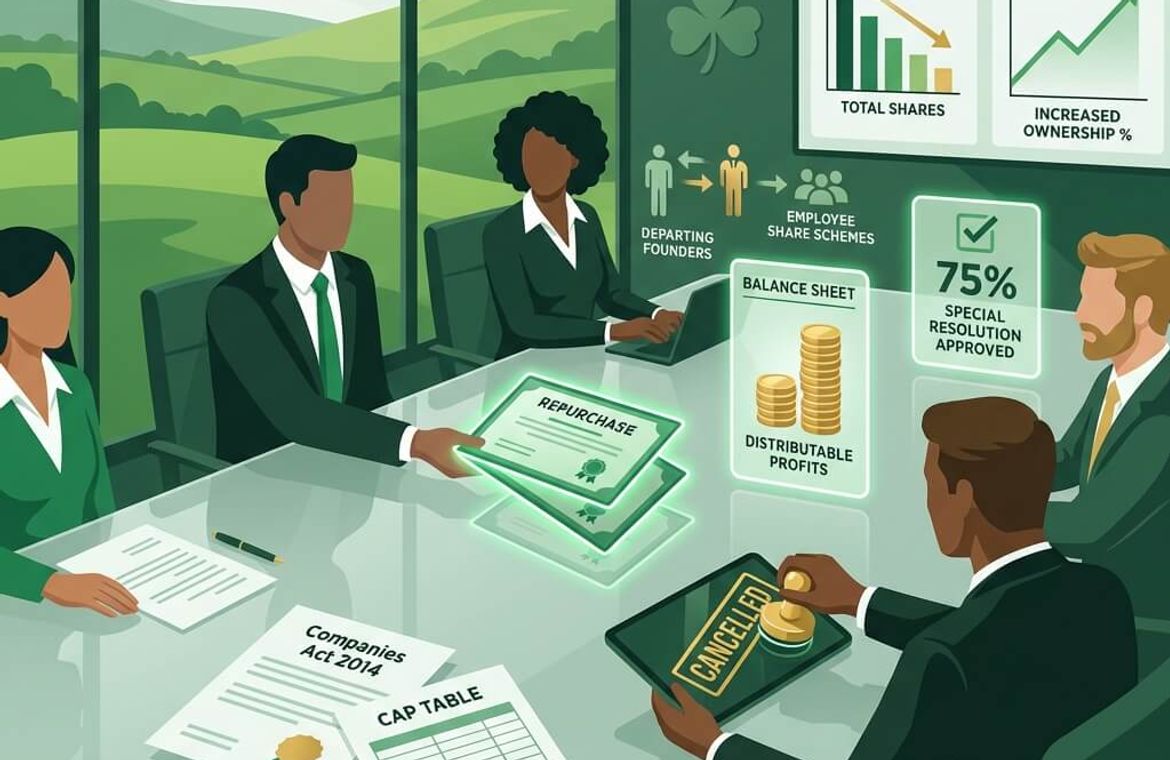
Founders, directors, shareholders, and advisors of Irish private limited companies considering share repurchases for cap table management, founder departures, or employee equity schemes.
They'll understand legal hurdles under Companies Act 2014, funding limits, approval processes, and when buybacks provide fairer, simpler outcomes than share transfers.
Key takeaways
- Irish companies need constitution permission, distributable profits or fresh issue funds, and 75% special resolution approval for share buybacks.
- Buyback shares are typically cancelled, boosting remaining shareholders' stakes without new issuances.
- Early-stage companies often can't buy back due to no distributable profits, needing alternatives like transfers.
- Buybacks excel for founder exits, pre-funding cap table tidy-ups, and employee scheme recoveries.
- Unlike transfers, buybacks remove shares entirely, avoiding concentration in one holder.
What Is a Share Buyback?
A share buyback, also called a share repurchase, is a transaction where the company itself purchases shares from one of its existing shareholders.
The company pays the shareholder an agreed price for their shares, those shares return to the company, and they are typically cancelled immediately, reducing the total shares in issue and adjusting the ownership percentages of the remaining shareholders accordingly.
This is different from a share transfer, where shares move from one shareholder to another and the total number of shares in issue stays the same.
When Can an Irish Company Buy Back Its Own Shares?
The rules governing share buybacks for private limited companies are set out in the Companies Act 2014, and three conditions must be satisfied before a buyback can proceed.
First, the company's constitution must permit it. Many standard constitutions include a provision allowing buybacks, but if yours is silent on the point, it will need to be amended by special resolution before a buyback can take place.
Second, the company must have sufficient distributable profits or must fund the buyback from the proceeds of a fresh share issue. This is the most important practical constraint. A company cannot use its share capital or general reserves to buy back shares: only profits that would otherwise be available for distribution to shareholders, or money raised by issuing new shares at the same time, can be used.
Third, the buyback must be approved by the shareholders through a special resolution: meaning at least 75% of votes cast at a general meeting, or a written resolution signed by shareholders holding 75% or more of the voting shares.
Where the buyback is of a modest size relative to the company's resources and the constitution already permits it, a board resolution alone may be sufficient in some circumstances; but a special resolution is the safer and more commonly used approach.
What Happens to the Shares After Repurchase?
In most cases, repurchased shares are cancelled immediately after the buyback completes.
Cancellation reduces the total number of shares in issue, which has the effect of increasing the proportionate ownership of the remaining shareholders without any new shares being issued to them. This is one of the reasons buybacks are used as part of employee equity schemes and cap table management: the dilution caused by earlier share issuances can be partially reversed.
Irish law does allow companies to hold repurchased shares as treasury shares rather than cancelling them immediately, but this is less commonly used in practice, as treasury shares carry no voting rights and no entitlement to dividends while held by the company.
The Funding Restriction in Practice
The requirement to fund a buyback from distributable profits is the constraint that most often prevents early-stage companies from using this route.
A company that is pre-revenue, loss-making, or has an accumulated deficit has no distributable profits: meaning a buyback funded from reserves is simply not available, regardless of how much cash sits in the bank.
In practice, this means: for many startups, a buyback is only viable once the company has reached profitability and built up retained earnings, or if the buyback is structured alongside a fresh share issue that generates the funding.
Where a company wants to remove a departed founder's shares but lacks distributable profits, alternative approaches, such as a share transfer to remaining founders or investors, or a drag-along or compulsory transfer mechanism under the shareholders' agreement, may be the only available options.
When Is a Buyback Better Than a Share Transfer?
Both routes remove a shareholder from the cap table, but they work differently and suit different situations.
A share transfermoves the shares to another named shareholder: typically a remaining founder or a new investor. It is straightforward and does not require distributable profits, but it requires someone to receive the shares, and it can create complications around valuation and stamp duty.
A share buyback removes the shares from circulation entirely, spreading the benefit proportionately across all remaining shareholders rather than concentrating it in one person's hands.
Buybacks tend to be the cleaner option in three specific scenarios:
- Departing founders: where a founder leaves the company and the remaining team want the shares cancelled rather than concentrated in any one person's hands, a buyback achieves that cleanly without requiring the departing founder to negotiate a transfer to a specific individual.
- Cap table simplification before a funding round: investors frequently ask founders to tidy up the cap table before a round closes. Cancelling small legacy shareholdings through a buyback is often faster and simpler than coordinating multiple individual transfers.
- Employee share schemes: where shares issued under an employee option plan need to be recovered following a leaver event, a buyback can be the most efficient mechanism, particularly where the constitution and option plan documentation already provide for it.
Irish Company Formation
Your Irish company, ready in days — not months.
Join 1,000+ founders who incorporated with Open Forest. We handle the paperwork, you focus on building.
No hidden fees/Fully compliant/Free consultation

Related articles


May 27, 2026 - 6 min read
Side Letters: Key Terms, Risks and Negotiation Tips for Irish Founders
Learn what investor side letters are, the terms they typically cover, risks for founders and how Irish startups can negotiate them without complications in future rounds.

May 26, 2026 - 9 min read
Zero Hour Contract Ireland: 2018 Act Rules Explained
Irish employers managing variable hours must follow the 2018 Act ban on zero hour contracts. This guide covers banded hours, minimum payments, if-and-when rules, and WRC compliance steps.

May 24, 2026 - 7 min read
Director Service Agreement Ireland: Founder Guide
Understand how Irish law treats directors as office-holders vs employees, and why founders need a written service agreement covering duties, pay, covenants, and termination.

Frequently asked questions
Here's everything you need to know to get started, manage your account, and troubleshoot the most frequent issues.
A share buyback, also called a share repurchase, is a transaction where the company purchases shares from existing shareholders at an agreed price. The shares return to the company and are typically cancelled immediately, reducing total shares in issue and increasing ownership percentages of remaining shareholders. Unlike transfers, total shares don't stay the same.
An Irish private limited company can buy back shares if three conditions are met: the constitution permits it, funding comes from distributable profits or fresh share issue proceeds, and shareholders approve via special resolution (75% votes). Board resolution may suffice for small buybacks if constitution allows.
Repurchased shares are usually cancelled immediately, reducing total shares outstanding and proportionally increasing remaining shareholders' ownership. Companies can hold them as treasury shares, but these have no voting rights or dividends while held by the company, less common in practice.
Buybacks must be funded from distributable profits available for shareholder distributions or proceeds of a simultaneous fresh share issue. Share capital or general reserves cannot be used. Pre-revenue or loss-making startups often lack distributable profits, blocking buybacks.
Buybacks are cleaner for departing founders (avoids concentrating shares), cap table simplification before funding (faster than multiple transfers), and recovering employee shares post-leaver events. Transfers require a recipient and may involve valuation/stamp duty issues, while buybacks benefit all remaining shareholders proportionately.
Questions are welcome.
We’ll point you in the right direction.
Share a few details below and our team will follow up with guidance for your Ireland or UK company.