
Bridge Round: What It Is, Differences & When to Raise
Discover what a bridge round is: an interim funding to extend runway between major raises. Learn differences from priced rounds, convertible instruments like SAFEs, risks, and when founders should use one for startups.
Who should read this
Startup founders facing funding gaps between rounds, investors evaluating early-stage opportunities, and entrepreneurs in tough markets seeking quick capital without full valuation.
Readers will learn to identify when bridge rounds boost growth versus delay problems, choose instruments, manage risks, and follow a framework for successful raises.
Key takeaways
- Bridge rounds provide short-term funding to extend runway and hit milestones before a larger raise, avoiding current low valuations.
- They use convertible instruments like SAFEs or loan notes with discounts and caps, faster than priced rounds.
- Ideal when near key achievements; risky if repeated without progress, leading to cap table complexity.
- Founders should define objectives, timeline (3-9 months), track cap table, and communicate plan.
- Warning signs: repeated rounds amid decline or without new investors signal deeper issues.
What is a bridge round?
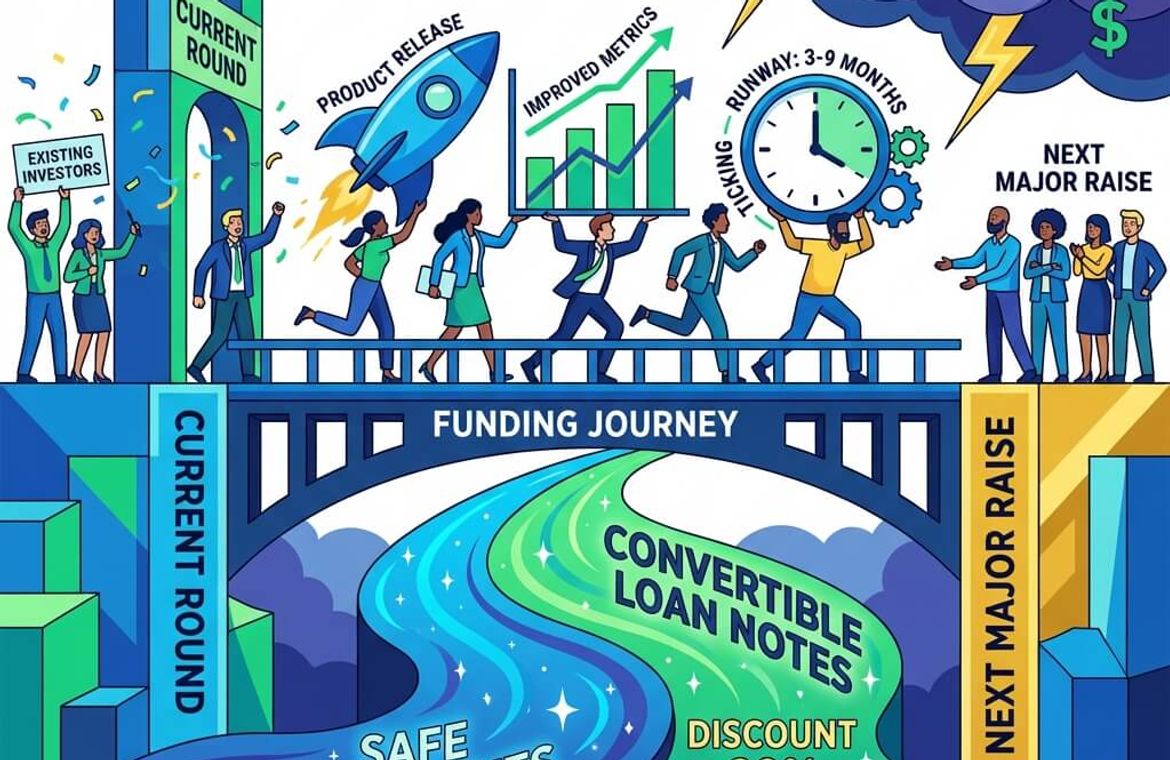
A bridge round is an interim funding round that sits between two larger investment rounds.
It is often used to:
- Extend runway by several months
- Reach key milestones before the next raise
- Avoid raising at a lower valuation
Bridge rounds are usually smaller and faster than full funding rounds. They focus on getting capital into the business quickly rather than negotiating a full valuation. They usually involve current investors familiar with the company, rather than new investors who would need to conduct their own due diligence, negotiate investment agreements etc.
In practice, this means a bridge round helps the company stay operational while preparing for a larger raise.
How is a bridge round different from a priced round?
A priced round is a funding round where the company’s valuation is agreed upfront and investors receive shares at that price.
A bridge round usually avoids setting a valuation. Instead, it uses instruments that convert into shares later.
What Does the Law Require?
Section 137 of the Companies Act 2014 mandates that every Irish company must have at least one director resident in the European Economic Area (EEA).
This requirement focuses on residency, not citizenship.
- Who Counts: A person resident in the EU, Iceland, Liechtenstein, or Norway.
- Residency Test: Presence in the State for 183 days or more in the preceding 12 months.
Examples:
✗ An Irish passport holder living in Australia would not satisfy the requirement.
✓ A German citizen living in Dublin would satisfy it.
The key difference is that a priced round sets the company’s value now, while a bridge round usually delays that decision until a future round.
What instruments are used in a bridge round?
Bridge rounds are usually structured using convertible instruments. These instruments convert into shares at a later date, typically during the next priced round.
Common instruments include:
- Convertible loan notes, which start as debt and convert into shares
- Simple agreements for future equity (SAFE), which convert directly into shares
- Other similar convertible arrangements
These instruments often include incentives for investors, sometimes referred to as sweeteners.
Typical sweeteners include:
- A discount on the future share price, usually around 20%
- A valuation cap, which sets a maximum valuation for conversion
In practice, this means bridge investors take more risk now and are rewarded with better terms later.
What are the risks of multiple bridge rounds?
Bridge rounds can be useful, but they can also create problems if used repeatedly.
Each bridge round adds more convertible instruments to the company’s cap table. Over time, these can stack up and become difficult to manage.
Common risks include:
- Increasing dilution when instruments convert
- Complex cap table calculations
- Investor confusion about ownership
- Reduced clarity on the company’s valuation
If several bridge rounds are raised before a priced round, the conversion mechanics can become complicated.
When is a bridge round a good idea?
A bridge round is usually sensible when it supports a clear and achievable plan.
Examples include:
- The company is close to a major milestone, such as launching a product
- The company expects improved metrics within a few months
- Market conditions make it difficult to raise a full round immediately
In these situations, a bridge round can help the company raise at a stronger valuation later.
In practice, this means a bridge round works best when it clearly leads to a better next funding round.
When is a bridge round a warning sign?
Not all bridge rounds are positive. In some cases, they signal underlying issues.
Warning signs include:
- Repeated bridge rounds without a clear plan
- Declining company performance
- Difficulty attracting new investors
- Reliance on existing investors to keep funding the business
These situations may indicate that the company is delaying a larger problem rather than solving it.
The key difference is that a strong bridge round supports growth, while a weak one delays difficult decisions.
How should founders approach a bridge round?
Founders should approach bridge rounds with a clear strategy and timeline.
Here is a practical framework to follow.
Step 1: Define the objective
Identify what the bridge round will achieve. This could be reaching a product milestone or improving key metrics.
Step 2: Set a timeline
Bridge rounds typically cover a short period, often 3 to 9 months. However, in unfavorable market conditions, bridge rounds can be used to provide cover much further beyond that.
Step 3: Choose the right instrument
Decide whether to use a convertible loan note, a simple agreement for future equity (SAFE), or another structure.
Step 4: Manage the cap table
Track all convertible instruments carefully to avoid complexity later. Terms should be consistent to avoid complications.
Step 5: Communicate with investors
Explain how the bridge round fits into the company’s overall fundraising plan.
Summary, bridge rounds help companies reach the next stage
A bridge round is a short term funding solution that helps companies raise money between larger investment rounds.
It usually uses convertible instruments and avoids setting a valuation upfront. This allows the company to raise quickly and delay valuation discussions.
Bridge rounds can be powerful when used correctly, but repeated use can create complexity and signal deeper issues.
We hope this guide has helped you understand what a bridge round is and when it makes sense to use one.
Irish Company Formation
Your Irish company, ready in days — not months.
Join 1,000+ founders who incorporated with Open Forest. We handle the paperwork, you focus on building.
No hidden fees/Fully compliant/Free consultation

Related articles


May 27, 2026 - 6 min read
Side Letters: Key Terms, Risks and Negotiation Tips for Irish Founders
Learn what investor side letters are, the terms they typically cover, risks for founders and how Irish startups can negotiate them without complications in future rounds.

May 26, 2026 - 9 min read
Zero Hour Contract Ireland: 2018 Act Rules Explained
Irish employers managing variable hours must follow the 2018 Act ban on zero hour contracts. This guide covers banded hours, minimum payments, if-and-when rules, and WRC compliance steps.

May 24, 2026 - 7 min read
Director Service Agreement Ireland: Founder Guide
Understand how Irish law treats directors as office-holders vs employees, and why founders need a written service agreement covering duties, pay, covenants, and termination.

Frequently asked questions
Here's everything you need to know to get started, manage your account, and troubleshoot the most frequent issues.
A bridge round is an interim funding round between larger investment rounds. It extends the company’s runway, helps reach key milestones, and avoids raising at a lower valuation. Usually smaller, faster, involving current investors with lighter documentation.
A priced round agrees on valuation upfront for shares. Bridge rounds avoid valuation, use convertibles like loan notes or SAFEs, are faster with lighter docs. Key difference: priced sets value now, bridge delays to future round.
Bridge rounds use convertible instruments: convertible loan notes (debt to shares), SAFEs (direct to shares). Often include sweeteners like 20% discount or valuation cap for investor incentives, rewarding early risk.
Raise when close to milestones like product launch, expecting better metrics soon, or tough markets. It supports a clear plan to achieve higher valuation next. Avoid if no plan or declining performance.
Multiple bridges add convertibles, causing dilution, complex cap tables, investor confusion, valuation clarity issues. Conversion mechanics complicate if stacked before priced round.
Questions are welcome.
We’ll point you in the right direction.
Share a few details below and our team will follow up with guidance for your Ireland or UK company.